























About Mario vs. Donkey Kong 2: March of the Minis
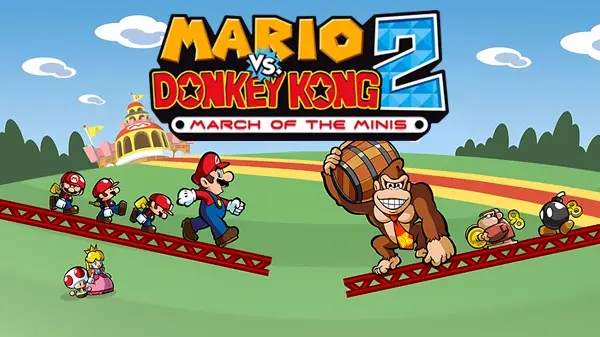
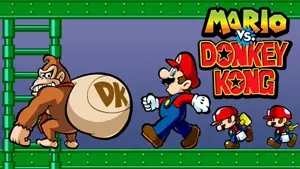
Mario vs. Donkey Kong 2: March of the Minis is a puzzle-platform game developed by Nintendo Software Technology and released for the Nintendo DS in 2007. It continues the Mario vs. Donkey Kong spin-off series but shifts the gameplay away from direct character control, focusing instead on guiding wind-up Mini Mario toys through complex obstacle courses. The experience blends puzzle design, timing, and environmental manipulation into a stage-based structure built for short but highly tactical play sessions.
The story takes place after Donkey Kong interrupts the opening of Super Mini Mario World theme park, causing chaos and capturing Pauline once again. Instead of Mario handling everything directly, the Mini Mario toys become the central tools for solving each situation. These small wind-up characters behave like autonomous units that move forward on their own once activated, and the player must carefully prepare the environment so they can survive hazards and reach the exit safely.
Each stage is designed like a mechanical puzzle machine, filled with interactive objects such as conveyor belts, ladders, springs, directional blocks, moving platforms, spikes, and switches. The layout often forces players to think several steps ahead, because once a Mini Mario starts moving, it cannot be directly stopped or redirected without modifying the stage itself. This creates a constant balance between planning and real-time adjustment, especially when multiple Minis are active at the same time.
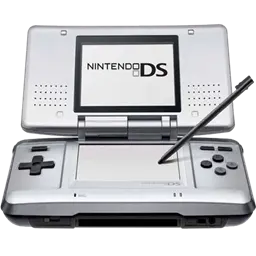
On Emulator Games Zone, it can be played through a NDS Emulator, preserving the dual-screen puzzle layout where planning and execution are visually separated between screens for clearer stage control.
How To Play
Mario vs. Donkey Kong 2: March of the Minis is built around indirect control mechanics. Instead of controlling Mario or the Minis directly in real time, players manipulate the environment to guide Mini Mario units from the starting point to the goal door.
Each Mini Mario automatically walks forward once activated, only turning when they encounter walls, edges, or directional devices. Players must place interactive objects like ladders, springs, and arrows to reshape the path and prevent the Minis from falling into traps or looping into dangerous areas. Because movement continues without stopping, timing environmental changes becomes a key part of every puzzle.
Many stages require managing multiple Minis at once. These units may start at different times or follow slightly different paths, so players need to ensure their routes do not interfere with each other. Mistimed placements can cause collisions, falls, or blocked progress, forcing a restart or careful correction.
As the game progresses, puzzles become more layered with moving hazards, timed switches, and multi-level structures. Later stages often require setting up chain reactions—activating one mechanism to trigger another—so that Minis can pass safely through increasingly complex layouts. Success depends on understanding movement behavior, planning routes in advance, and adjusting the stage quickly as situations change in real time.