








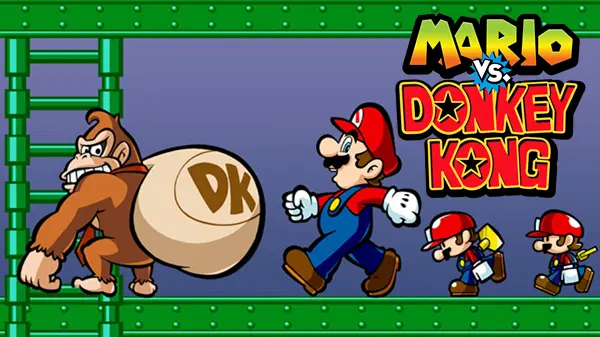





















About Mario vs. Donkey Kong
Mario vs. Donkey Kong is a puzzle-platform game developed by Nintendo Software Technology and released for the Game Boy Advance in 2004. It reimagines the classic Mario and Donkey Kong rivalry in a more puzzle-driven structure, combining traditional platforming movement with stage-based logic challenges. Instead of focusing purely on speed or reflexes, the game asks players to read each level carefully and figure out how to safely navigate complex layouts filled with traps, moving parts, and enemy patterns.
The story begins when Donkey Kong becomes frustrated after failing to find Mini Mario toys in stores and decides to steal a batch for himself. Mario sets out to recover them, traveling through a series of themed worlds that gradually increase in difficulty. Each world introduces new mechanics, from simple switches and ladders to conveyor belts, elevators, and tightly timed platform sections. The overall structure feels closer to a sequence of compact puzzle rooms rather than long scrolling stages, with each level built around a specific idea or mechanical interaction.
What makes the game stand out is how it blends platforming precision with puzzle-solving. Instead of just reaching the end, players must often retrieve a key, unlock a door, and sometimes escort or rescue Mini Marios before completing the stage. Enemy placement and object timing are carefully designed so that brute force movement rarely works—progress depends on observing patterns and planning a safe route through each section.
On Emulator Games Zone, it can be played through a GBA Emulator, keeping the original handheld experience intact with its focused level design and quick-restart puzzle structure.
How To Play
Mario vs. Donkey Kong uses direct character control, where players guide Mario through compact puzzle-platform stages filled with hazards and interactive objects. Movement includes running, jumping, climbing ladders, and interacting with switches that change the environment.
Each level typically centers around collecting a key and reaching a locked exit door. However, the key is often placed in a separate or harder-to-reach area, requiring players to activate mechanisms such as moving platforms, timed switches, or rotating structures to build a safe path. Enemies patrol fixed routes, and learning their movement patterns is important for finding safe timing windows.
Platforming precision is essential, especially in later stages where gaps become narrower and hazards more frequent. Conveyor belts, collapsing platforms, and moving lifts introduce additional timing pressure, forcing players to adjust movement rhythm instead of relying on simple jumps.
As progression continues, stages combine multiple mechanics at once, creating more layered puzzle designs. Players often need to think a few steps ahead—deciding when to activate switches, how to route movement through hazards, and how to avoid trapping themselves in dead ends while still meeting the stage objective.