
About Mario Party 2
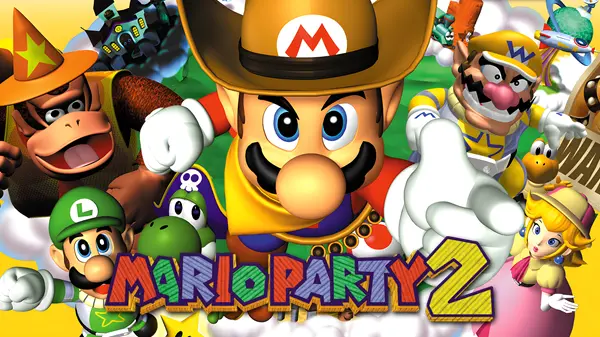
Mario Party 2 is a party-style board game developed by Hudson Soft and released by Nintendo for the Nintendo 64 in 1999. It builds on the foundation of the original Mario Party but pushes more personality into the experience, turning simple board movement into a mix of strategy, luck, and constant mini-game interruptions. Mario, Luigi, Peach, Yoshi, Wario, and others compete across themed boards where each match feels different depending on how the dice rolls and events unfold.
Unlike traditional board games, Mario Party 2 doesn’t stick to a single tone or setting. Each board is built around a specific theme—like a Western town, a pirate sea, or a haunted area—and the rules of the board often reflect that theme. Characters even wear costumes that match the world they’re playing in, which makes each match feel like a small themed story rather than just a game session. The main objective stays consistent: collect stars and coins, but how players reach them is constantly disrupted by events, traps, and unpredictable board mechanics.
Originally released exclusively on Nintendo 64, the game is widely remembered for tightening the pacing and making mini-games feel more tightly integrated into every turn. On Emulator Games Zone, it can be played through an N64 Emulator, allowing the full board experience to run directly in-browser without needing original hardware.
How To Play
Mario Party 2 plays like a turn-based board game where each player rolls a dice block to move around the map. Movement is the core of the game, but every space you land on changes the flow—some give coins, some trigger events, and others can activate traps or special board effects tied to that specific map. Positioning matters because stars appear in set locations, and reaching them at the right moment often decides the outcome of the match.
After all players take their turns, a mini-game begins. These mini-games vary between free-for-all battles, 2v2 team matches, and 1v3 asymmetric challenges. Each one is short but competitive, often focusing on timing, button precision, or simple reaction control. Winning mini-games is one of the main ways to build coin advantage, which is essential for purchasing stars later in the match.
Items add another layer of decision-making. Players can use them to modify dice rolls, steal coins from opponents, or change movement outcomes on the board. Some items are designed to disrupt others at key moments, especially when someone is close to a star or has a large coin lead.
Each board also introduces its own mechanics that can completely shift strategy. Certain maps change star locations dynamically, while others include hazards that can push players backward or trigger sudden coin loss. Because of these systems, matches rarely follow a predictable path, and even a player in the lead can quickly lose control if the board events turn against them.