



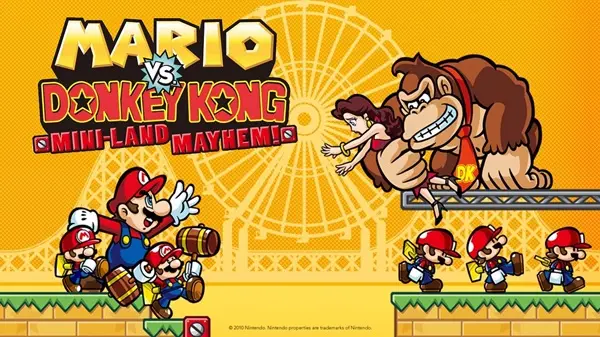












About Mario vs. Donkey Kong: Mini-Land Mayhem
Mario vs. Donkey Kong: Mini-Land Mayhem is a puzzle-platform game developed by Nintendo Software Technology and released for the Nintendo DS in 2010. It continues the Mario vs. Donkey Kong series with a stronger focus on logic-based stage design, where players guide wind-up Mini Mario toys through complex obstacle courses instead of controlling Mario directly. The game builds on earlier entries by expanding the scale of puzzle interactions and introducing more flexible level creation mechanics within its main campaign structure.
The story begins when Donkey Kong once again disrupts a theme park opening, causing chaos and leading Mario to chase after him. Along the way, Mario collects Mini Mario toys and uses them as the core tools for solving each stage. Unlike traditional platformers, the Minis move automatically once activated, forcing players to carefully design safe routes through each environment before they start moving.
Each level is built like a mechanical puzzle board filled with interactive elements such as elevators, conveyor belts, springs, switches, and directional tiles. The challenge comes from arranging and timing these objects so that multiple Minis can safely reach the goal at the same time. As the game progresses, stages become more layered, requiring players to manage overlapping paths and synchronized movement across different sections of the map.
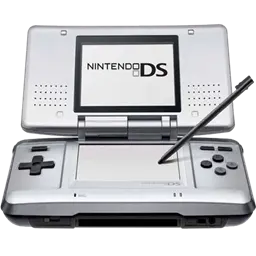
On Emulator Games Zone, it can be played through a NDS Emulator, keeping the dual-screen puzzle layout that separates planning tools and live movement visualization for clearer control.
How To Play
Mario vs. Donkey Kong: Mini-Land Mayhem focuses on indirect control puzzle-solving, where players do not directly move characters but instead build and modify pathways for Mini Mario units.
Each Mini Mario starts moving automatically once placed on the track. Players must position ramps, platforms, springs, and directional arrows to guide them safely toward the exit. Since Minis cannot be stopped mid-route, every placement must be planned carefully before activation.
Many levels introduce multiple Minis at once, requiring coordination between different movement paths. Players must ensure that each Mini avoids hazards while also preventing collisions or blocked routes. Timing becomes important when activating switches or moving platforms that affect several Minis simultaneously.
As stages become more complex, puzzles begin to require chain reactions—activating one mechanism to trigger another so that Minis can pass through multiple obstacles in sequence. Success depends on understanding movement patterns, predicting interactions between objects, and refining layouts through trial and adjustment until all Minis reach the goal safely.