



About Mario Party DS
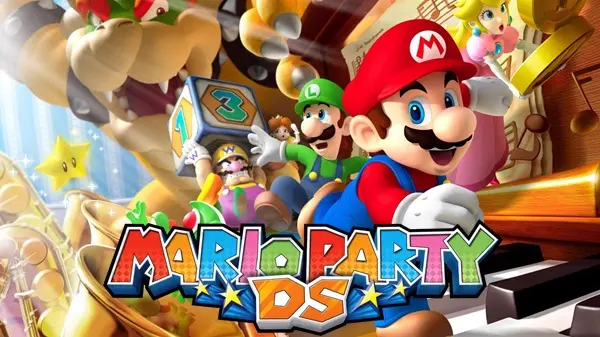
Mario Party DS is a party-style multiplayer game developed by Hudson Soft and released for the Nintendo DS in 2007. It brings the familiar Mario Party board game formula into a handheld format, built around short matches, touch-based mini-games, and a compact board structure designed specifically for portable play.
The game’s story sets Mario and his friends on a much smaller scale adventure after they are shrunk down by Bowser during a celebration. From this point, they must travel across miniature-themed boards, each with its own layout, hazards, and shortcuts, in order to collect Stars and regain their normal size. The tone is light and playful, with each board designed to feel like a small tabletop world filled with traps, item spaces, and unpredictable events.
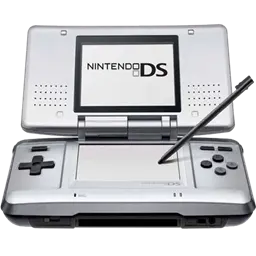
Unlike console entries that often rely on longer sessions, this version is structured for shorter, faster-paced rounds. The Nintendo DS hardware is used heavily for mini-games, many of which rely on touch controls, stylus drawing, quick taps, or simple directional input. This gives the game a more hands-on feel compared to traditional button-only party games, especially in reaction-based challenges and timing puzzles.
On Emulator Games Zone, it can be played through a NDS Emulator, preserving the board-game flow and fast mini-game transitions designed for handheld competition.
How To Play
Mario Party DS is played on a board where players take turns rolling dice to move across spaces, aiming to collect Stars while managing coins and items. Each board has different layouts with branching paths, traps, and shortcuts that can change the outcome of a match quickly.
After each round of movement, a mini-game begins where all players compete for coins. These mini-games vary widely in style, including touch-based challenges, timing-based reflex tests, and small puzzle tasks. Winning these mini-games is crucial, as coins are needed to purchase Stars from designated locations on the board.
Items play an important strategic role. Players can use them to alter dice rolls, steal coins, or disrupt opponents’ movement. Some items allow direct interaction with the board, such as changing paths or blocking access to key areas, adding a layer of tactical decision-making beyond simple dice luck.
The game balances randomness with strategy—while dice rolls determine movement, smart use of items, board positioning, and mini-game performance all influence the final outcome. Matches can shift quickly, especially in the later stages where Stars become harder to reach and player interaction becomes more aggressive and competitive.