



About Tomb Raider Chronicles
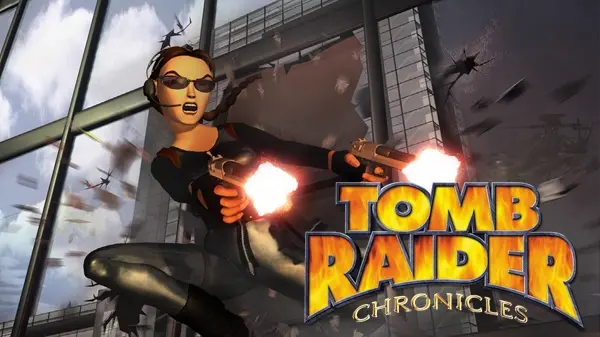
Tomb Raider Chronicles is an action-adventure game developed by Core Design and published by Eidos Interactive, released in 2000 for PlayStation, Dreamcast, and PC. It is the fifth entry in the Tomb Raider series and serves as a narrative follow-up that reflects on Lara Croft’s past adventures through a series of episodic missions.
The story begins after Lara is presumed dead following the events of The Last Revelation. At a memorial gathering, her close allies recount previously untold stories from her past expeditions. These flashback missions form the structure of the game, each set in a different location and time period from her earlier career.
Unlike the more continuous structure of previous entries, Chronicles is divided into standalone chapters, each with its own setting and tone. Players travel through locations such as Rome, a Russian submarine base, a high-security corporate facility, and rooftop environments in urban cities. This variety creates a more fragmented but diverse exploration experience.
The game also introduces younger versions of Lara in certain segments, offering slightly different movement styles and tools depending on the mission. While the core gameplay remains focused on exploration and puzzle-solving, some levels emphasize stealth and tighter indoor navigation compared to earlier entries.
Players visiting Emulator Games Zone can experience Tomb Raider Chronicles through the PlayStation emulator and revisit a collection of untold stories from Lara Croft’s past adventures.
How To Play
Tomb Raider Chronicles retains the classic third-person exploration system but structures gameplay into separate mission-based chapters. Each chapter functions as an independent level with its own environment, objectives, and pacing.
Movement and platforming remain central to progression. Players must carefully time jumps, climb structures, and navigate narrow ledges across varied environments ranging from ancient ruins to modern industrial interiors. Precision is important, especially in confined or vertical spaces.
Combat is present but generally secondary to exploration. Lara uses her signature dual pistols along with other weapons found throughout levels, but encounters are spaced out to maintain a focus on traversal and puzzle-solving.
Puzzle design varies between missions, with some chapters emphasizing mechanical switches and environmental manipulation, while others rely more on observation and exploration of compact indoor spaces. This episodic structure makes each level feel distinct in both layout and gameplay rhythm.
Certain missions introduce stealth-like elements, where avoiding detection or moving carefully through guarded areas becomes more important than direct confrontation. These sections add variation to the traditional Tomb Raider formula.
The overall experience feels like a collection of short stories rather than a single continuous journey, offering different interpretations of Lara Croft’s past adventures while maintaining the core exploration-driven gameplay the series is known for.