






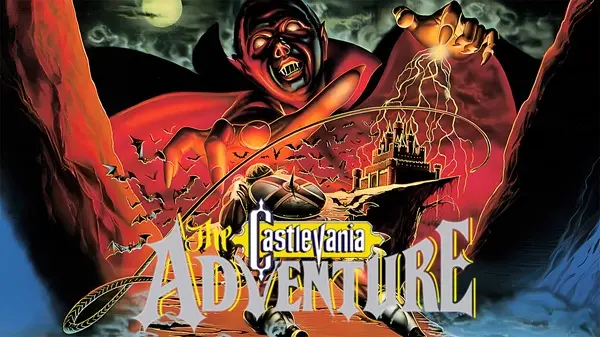



About Castlevania: The Adventure
Castlevania: The Adventure is an early action-platformer developed and published by Konami, released in 1989 for the Game Boy. It is one of the first handheld entries in the Castlevania series and follows Christopher Belmont, an ancestor of Simon Belmont, as he begins his first battle against Dracula in a darker, more restrained portable setting.
The game takes place in Dracula’s cursed territory, where monsters roam through forests, caves, and ruined fortresses. Unlike later Castlevania titles, this entry focuses on a slower, more deliberate pace, shaped heavily by the limitations of early Game Boy hardware. Despite that, it still builds a strong gothic tone through simple visuals, atmospheric music, and tightly structured levels.
Christopher’s journey is framed as a direct confrontation with Dracula’s rising influence, with each stage pushing deeper into hostile territory filled with traps, flying enemies, and environmental hazards. Even though the scale is smaller than later entries, the sense of progression—moving from open wilderness into Dracula’s inner stronghold—gives the adventure a clear sense of direction and tension.
At Emulator Games Zone, you can experience Castlevania: The Adventure on a Game Boy emulator, playable instantly in your browser while revisiting one of the earliest chapters of the Belmont saga.
How To Play
In Castlevania: The Adventure, you control Christopher Belmont through side-scrolling stages filled with enemies, platforms, and hazards. The main weapon is the whip, which is used for both attacking and maintaining distance from enemies. Unlike later Castlevania games, the whip in this version feels more limited in reach and speed, so timing becomes especially important in every encounter.
Each level is built around careful movement rather than fast action. Platforms are often spaced with tight jumps, and enemies tend to appear in patterns that punish rushed decisions. Many sections require pausing before moving forward, observing enemy behavior, and choosing the right moment to strike or jump.
Sub-weapons exist but are more limited in usage compared to later entries. Collecting hearts allows you to use special attacks such as axes or daggers, which can help clear difficult enemies or deal extra damage to tougher bosses. Because resources are scarce, players often rely more on precise whip attacks than constant sub-weapon usage.
Boss fights at the end of each stage are straightforward but demanding, usually centered around predictable attack patterns that require patience to overcome. Learning when to attack safely is often more important than dealing rapid damage, especially in later levels where bosses become faster and more aggressive.
Progressing through the game feels like a gradual climb in difficulty, with each stage introducing slightly more complex enemy layouts and platforming challenges. Mastery comes from adapting to its slower rhythm—careful movement, controlled jumps, and disciplined combat all play a role in surviving Dracula’s domain.