






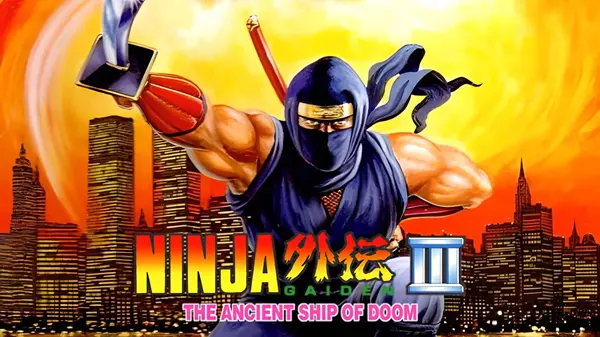



About Ninja Gaiden III: The Ancient Ship of Doom
Ninja Gaiden III: The Ancient Ship of Doom is a classic action-platformer released for the NES (Famicom) in 1991 in Japan and North America, developed and published by Tecmo. It is the third entry in the original Ninja Gaiden trilogy and continues the cinematic, story-driven ninja action the series is known for, while introducing a darker, more science-fiction-oriented tone.
The story follows Ryu Hayabusa, who becomes entangled in a mysterious military conspiracy after being framed for a series of murders he did not commit. As he investigates, Ryu uncovers a plot involving genetic experiments, energy manipulation, and a massive floating fortress known as the “Ancient Ship of Doom.” The narrative leans more heavily into sci-fi compared to the earlier games, mixing ninja themes with futuristic military technology.
Gameplay keeps the series’ fast-paced side-scrolling structure but adds a stronger focus on action flow and environmental interaction. Stages take place across industrial complexes, high-tech labs, military zones, and the massive airborne ship itself, creating a more unified and continuous journey compared to earlier entries.
Combat revolves around Ryu’s sword techniques and sub-weapons, with an emphasis on fast movement and continuous engagement. The game introduces more aggressive enemy placement and tighter stage design, pushing players to react quickly rather than rely on cautious progression.
One of the noticeable design shifts in Ninja Gaiden III is its increased pacing. Compared to its predecessors, the game reduces downtime and keeps players moving forward at a steady rhythm, with fewer interruptions between action segments.
How To Play
In Ninja Gaiden III: The Ancient Ship of Doom, players control Ryu Hayabusa through side-scrolling stages filled with enemies, traps, and fast-paced combat scenarios. The objective is to push through each level while surviving constant enemy pressure and environmental hazards.
Ryu can run, jump, climb walls, and attack using his sword, which serves as the primary close-range weapon. Sub-weapons collected during gameplay provide ranged attacks that help manage enemies positioned at different heights or distances. These tools are especially useful in tighter areas where enemies appear quickly from multiple directions.
The game emphasizes forward momentum. Unlike earlier entries, stages are designed to keep players moving at a more consistent pace, with fewer slow exploration sections. This creates a more continuous flow of combat and platforming.
Players will encounter a mix of ground-based soldiers, flying enemies, and environmental obstacles such as collapsing platforms and moving hazards. Timing jumps and attacks becomes essential, especially when enemies interrupt movement paths.
Boss encounters often take place in confined arenas and rely on pattern recognition. Players must learn attack cycles and identify safe windows to strike while avoiding projectile-heavy assaults. These fights are designed to test both reaction speed and weapon management.
Overall, the gameplay focuses on fast reactions, constant movement, and efficient use of both melee and ranged attacks to survive increasingly intense stages.